
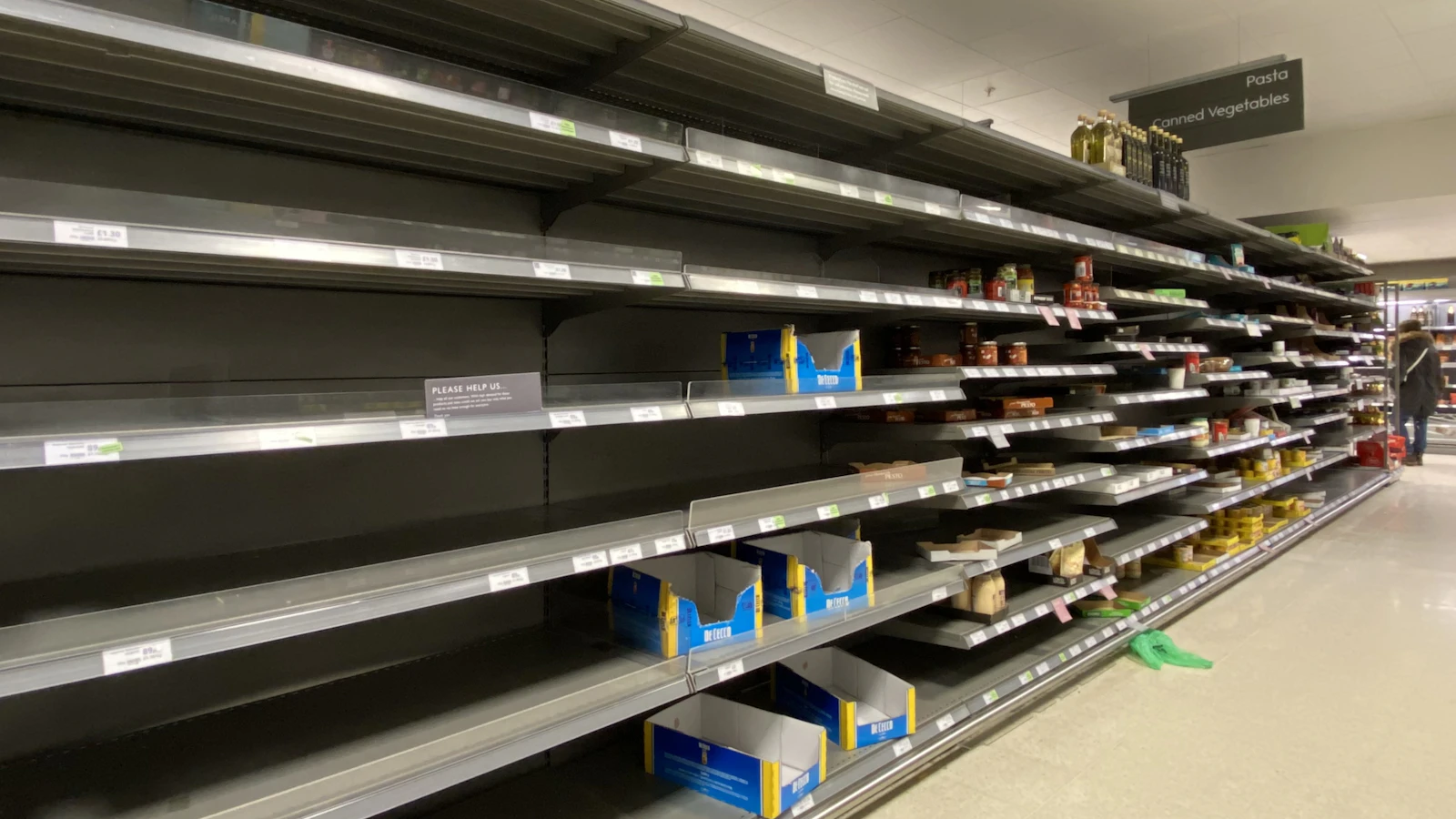
A stockout is not decided the day the shelf is empty: it is decided the day you should have ordered. The reorder point is your daily sales multiplied by your supplier’s lead time, plus a safety reserve. On the product worked through below: 12 a day, 5 days of lead time, 3 days of safety, so you order at 96 units. Below that number you will run out before the delivery lands. Far above it, you are financing stock that sleeps.
In short
- Reorder point = (daily sales × lead time) + safety. Here (12 × 5) + 36 = 96 units.
- The lead time is yours, not the sales rep’s. Measure it on your last three deliveries.
- Safety stock is a decision, not a calculation. It is paid for in tied-up cash.
- One threshold per product, on the twenty lines that make your turnover. Not on the other eight hundred.
- The threshold lives in the till, not in your head: it is an alert, not a memory.
The four numbers, and where to actually read them
Three are measured, one is decided. Confusing the two is the error that produces stockouts and overstock at the same time.
| The number | What it is | Where to read it |
|---|---|---|
| Average sales per day | How much leaves per day, averaged over four weeks. | The sales-by-product report, not memory. |
| Lead time | From purchase order to goods on the shelf, not to the lorry arriving. | Your last three deliveries, dated. |
| Safety stock | What you accept tying up to absorb a late delivery. | A management decision. Nobody can hand it to you. |
| Actual stock on hand | What is there right now, back room included. | The product record, if your stock is kept up to date. |
The fourth is the trap. A threshold computed against a wrong theoretical stock fires at the wrong time: too early on products you think you have, too late on the ones already gone. That is why reordering depends on counting, and why we wrote how to count a shelf without closing first.
The calculation, on one product
Take a line that moves well: it sells 84 units a week and your supplier delivers in 5 days. You order from them every 7 days.
| Line | Calculation | Result |
|---|---|---|
| Average sales per day | 84 sold over 7 days | 12 a day |
| Supplier lead time | ordered Monday, on the shelf Saturday | 5 days |
| Safety cover | 3 days, a decision | 36 units |
| Reorder point | (12 × 5) + 36 | 96 units |
| Order-up-to level | (12 × (5 + 7)) + 36 | 180 units |
| Quantity to order | 180 − 96 | 84 units |
Read the bold line: at 96 units on the shelf, you order. During the 5 delivery days about 60 will sell, and you will touch the bottom of the safety stock without running out. You order 84 units, which puts you back at 180: enough to last until the next order, plus the lead time, plus the safety.
Now the price of that comfort, because it is half the question. At 9 MAD purchase cost per unit, taken as an example, those 36 safety units are 324 MAD asleep permanently on this one line. Across 40 lines managed the same way, that is 12 960 MAD tied up in the shop. It is a legitimate choice, but it has to be made with open eyes: every extra day of safety is paid for in cash.
Turn it into an alert, not a sticky note
Six steps, once per product. After that the software does the work for you.
- Pull the sales ranking for the last four weeks and keep the top twenty lines. They make most of the turnover and they are the only ones worth this effort.
- For each, divide sales by the number of trading days, not by 30. A shop that closes on Friday lunchtime does not have thirty selling days in a month.
- Date your last three deliveries from that supplier and keep the longest lead time, not the average.
- Choose the safety cover: two days for a regular supplier delivering in town, more for an import or a single weekly delivery.
- Enter the threshold in the product record in your POS, as minimum stock or alert stock depending on what it calls it.
- Read the alert list on the same day every week, before placing orders. An alert nobody reads is worth nothing.
Step 2 is the one that corrupts everything else when it is done quickly. Dividing a month of sales by 30 in a shop that opened 26 days understates daily sales by 13 %, and a threshold 13 % too low is one stockout a quarter.

A threshold is not an automatic order
BelloPOS alerts you when a product falls below its threshold and gives you the list; it does not place the order, does not know your suppliers and negotiates nothing. That is deliberate: real automatic reordering needs up-to-date supplier catalogues, which almost no Moroccan wholesaler publishes. If a vendor promises you automatic ordering, ask which supplier it actually works with, and against which catalogue.
What shifts the numbers in Morocco
Lead time, first, is rarely a constant. Between a city wholesaler delivering next day, a regional depot at three days and an import taking weeks, the same shop runs three very different lead times on the same shelf. It is the longest one that sets the threshold, not the average: the average puts you out of stock half the time.
Then strong seasonality. Ramadan, the two Eids and the school return move daily sales by a factor no four-week average anticipates. The rule is simple: recompute the thresholds of the affected lines three weeks before the season, using the same period’s sales from last year, then put them back to normal after. The weekly review described in our numbers to check every week exists precisely to spot that moment.
Finally, buying for cash. Many Moroccan shops buy at the wholesale market in cash, which caps the order at whatever is in the drawer that morning. In that case the threshold mostly serves to choose: the alert list sorted by turnover tells you which lines have to go before the others when the day’s budget does not cover everything.
Products that need no threshold
Computing a threshold on eight hundred lines is an efficient way of respecting none of them.
- Short-life perishables: ordered on yesterday’s sales, not on a threshold.
- One-off pieces: jewellery, craft, a single-size garment. A threshold means nothing.
- End of line: the point is not to buy it again.
- Very slow movers: one sale a quarter is handled on demand, not from stock.
- Whatever the supplier delivers same day: the lead time is nil, so the threshold is too.
Mistakes to avoid
- Taking the promised lead time instead of the one observed on your own delivery notes.
- Dividing by 30 days in a month the shop opened 26.
- One threshold for the whole shop. Milk and a car battery share neither lead time nor turnover.
- Computing a threshold against a wrong theoretical stock. Count first, calculate second.
- Inflating safety for comfort. Every day added is paid for in tied-up cash, and it can be costed.
Frequently asked questions
How do you calculate a reorder point?
Average daily sales multiplied by the lead time, plus safety stock. In this article’s example: 12 units a day × 5 days of lead time = 60, plus 36 safety units, so a threshold of 96 units. When the shelf drops to that level, you order.
How much should you order once the threshold is hit?
Enough to climb back to the order-up-to level, which covers the lead time plus the interval between two orders plus safety: (12 × (5 + 7)) + 36 = 180 units. Starting from the 96 threshold, that is 84 units to order.
How many days of safety stock do you need?
It is a decision, not a calculation: two to three days for a regular supplier delivering in town, more for an import or a single weekly delivery. Every day added is tied-up cash: at 9 MAD a unit and 12 sales a day, one extra day of safety costs 108 MAD on that single line.
Do all products need a threshold?
No. Do it on the twenty to thirty lines that make most of your turnover, and leave the rest to judgement. A short-life perishable, a one-off piece or an end-of-line item is not managed on a threshold.
Can a till order by itself?
BelloPOS alerts and lists the products below their threshold; it does not place the order. Genuinely automatic reordering assumes an up-to-date electronic supplier catalogue, which very few Moroccan wholesalers publish today.
What to take away
Reordering by eye costs twice: in lost sales when the shelf is empty, and in cash when it is too full. The remedy fits in one evening’s work: your twenty best lines, four weeks of sales, each supplier’s real lead time, a safety decision you own, and a threshold entered in the product record. After that the only discipline left is reading the alert list on the same day every week.
The threshold in the product record, the alert on time
BelloPOS keeps a minimum stock per product, lists the lines that have fallen below their threshold and updates stock on every sale and every goods-in. Lite licence free for life, entirely offline.
Read next
Other practical guides on the same subject: