A restaurant asks a till for three things a retail shop never does: hold tables open, split a bill without irritating anyone, and send dishes to the kitchen without losing paper. Here is how uniCenta oPOS, Aronium and BelloPOS handle that, with the real plugin names and the real prices.
The short answer
- Aronium answers with plugins, and they are well named: print stations at 5 dollars a month to send to the kitchen and the bar, named orders and the takeaway option, both free.
- uniCenta oPOS has native restaurant screens and can send to several printers and to a kitchen display, with no plugin to buy.
- BelloPOS Pro brings the full restaurant module: table management, kitchen display, networked terminals and a web cashier app, for 40,000 MAD paid once.
- Aronium Pro plus two plugins comes to about 1,880 MAD a year, which is still by a wide margin the cheapest option.
- The decision turns on Arabic, support and duration. Over five years Aronium wins; over ten, and if your receipts must print in Arabic, the reading reverses.
The solutions compared
Three desktop programs, three ways of holding a service. The two international ones are excellent and cheap; what they lack for a Moroccan restaurant is specific, and this page names it.
uniCenta oPOS

A Java desktop till published under the GNU GPL v3 free licence. Multi-location, multi-terminal, multi-user, 17 languages, backed by a MySQL or MariaDB database. Version 5.4.0 added a WooCommerce integration. The project is distributed on SourceForge, where its last update is dated 10 August 2025.
Aronium

A native Windows till in two editions: Aronium Lite, free and with no registration, and Aronium Pro, which connects several registers to one database. Everything else is added through plugins, free or paid, billed per store.
BelloPOS

Our Windows till software, built in Morocco. It runs 100% offline: no sale depends on the connection. The interface and the receipts exist in French, Arabic and English. Three tiers: Lite free for life, Go and Pro bought once, never subscribed to.
The comparison, criterion by criterion
A service’s criteria, in the order the dining room imposes them.
| The criterion | uniCenta oPOS | Aronium | BelloPOS |
|---|---|---|---|
| Table management | Native restaurant screens, with a floor plan. | Named orders (free plugin) to track customers in the room. | Table management in Pro’s restaurant module. |
| Sending to the kitchen | Outputs to several printers and to a kitchen display, included. | Print stations plugin, $5 a month per store. | Kitchen display included in Pro. |
| Split bills | Yes, built into the restaurant screens. | Yes, test it on your exact case during the trial. | Yes, in the restaurant module. |
| Takeaway and dine-in | Depends on how the screens are configured. | Takeaway plugin, free, which distinguishes the two and highlights them. | Handled in the restaurant module. |
| Several tills on the floor | Yes, natively, on a shared database. | Aronium Pro, $100 a year per store. | Networked terminals on Pro. |
| Works offline | Yes. | Yes. | Yes, 100% offline. |
| Kitchen ticket in Arabic | Depends on configuration and font. | Depends on configuration. | Built in and tested on thermal printers. |
| Realistic annual cost | 0 MAD for the software, plus your administration time. | About 940 MAD, or 1,880 MAD with print stations and price lists. | 40,000 MAD once for Pro, then nothing. |
| Support on a Saturday night | Community forum. | Online help centre. | Phone and WhatsApp in Darija, priority for 3 months with Pro. |
| Who it suits | A restaurant with someone technical on the team. | A small restaurant wanting the lowest cost with no Arabic or Moroccan invoicing requirement. | An established Moroccan restaurant wanting a kitchen display and Arabic receipts with no monthly bill. |
What it really costs over five years
The cost of an equipped restaurant over five years. The Aronium restaurant line adds the two plugins a service actually uses: print stations and price lists.
| The solution | Over 1 year | Over 3 years | Over 5 years |
|---|---|---|---|
| Aronium Pro ($100/year per store) | 940 MAD | 2,820 MAD | 4,700 MAD |
| Aronium Pro + print stations + price lists | 2,068 MAD | 6,204 MAD | 10,340 MAD |
| BelloPOS Pro (40,000 MAD, once) | 40,000 MAD | 40,000 MAD | 40,000 MAD |
| Moroccan reference: Caisse Manager, till + stock + mobile (410 MAD/month) | 4,920 MAD | 14,760 MAD | 24,600 MAD |
The amounts above are worked out from the public prices recorded on 27 July 2026, with VAT added where a price is quoted excluding tax, and with no commercial discount. For prices in dollars, the rate used: 1 USD = 9.4 MAD, recorded 27 July 2026. Redo the sum with the day’s prices before you decide: they move, and it is your money.
The finding is clear and we will not dodge it: Aronium remains by far the cheapest option, even with its two food service plugins. What 40,000 MAD buys against that is a full restaurant module, a kitchen display, networked terminals, tested Arabic receipts and three months of priority support in Darija, paid once. Whether that gap is justified for your dining room is your call; it is not justified for every one.
A Friday night, station by station
Here are the six moments in a service where a restaurant till is judged, and what each of the three actually does at them.
- Opening tables. uniCenta has native restaurant screens with a floor plan, which is the most developed of the three on this specific point. Aronium leans on its free named orders plugin, which gives every open order a name: less visual, but effective and free. BelloPOS Pro handles tables in its restaurant module.
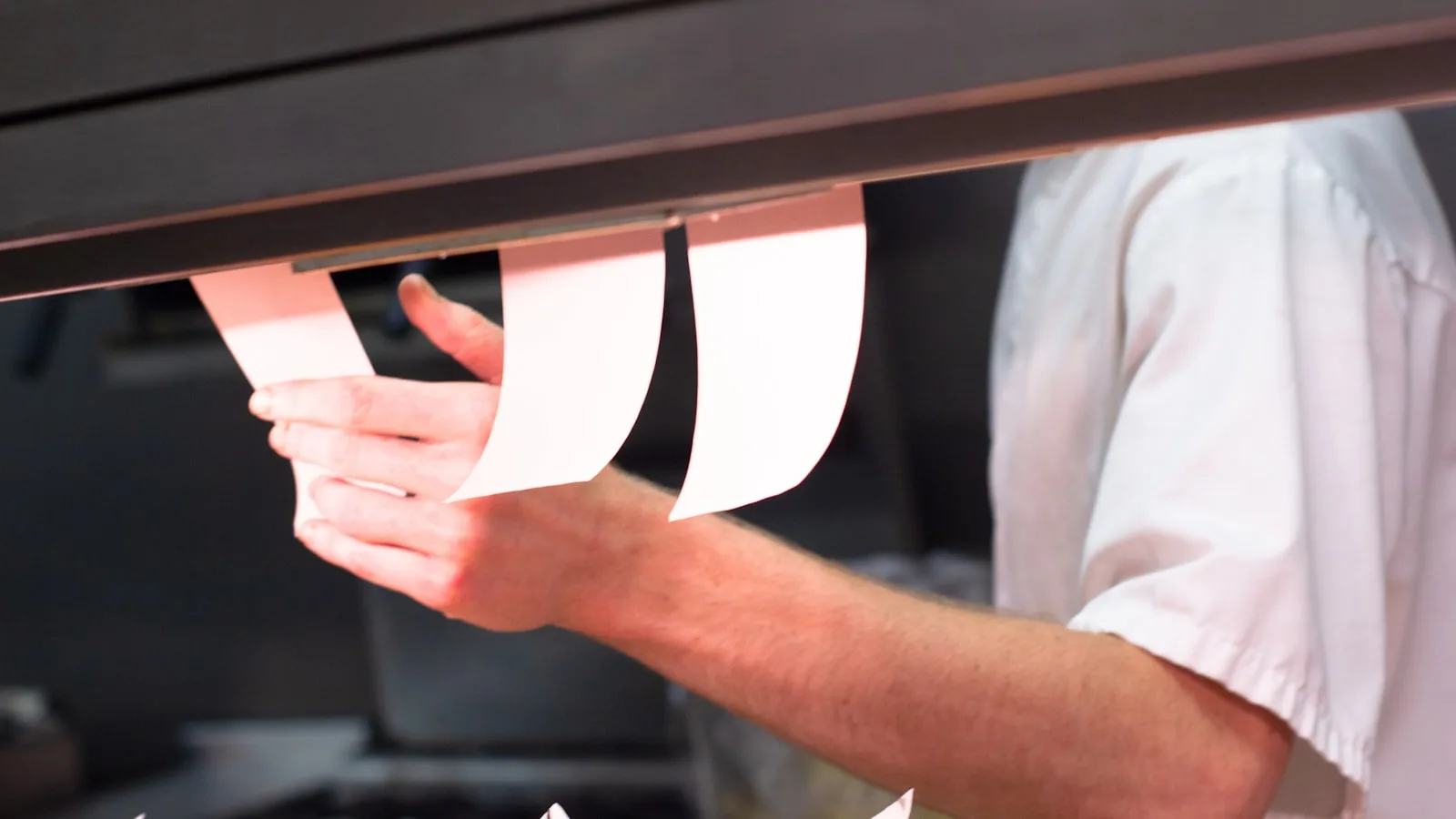
- Sending to the kitchen. This is where Aronium’s “print stations” plugin at 5 dollars a month earns its keep: it sends order lines to the kitchen printer and the bar printer separately. uniCenta does it with no plugin. BelloPOS Pro offers a kitchen display, which removes the paper rather than printing it better.
- Adding a dish to an already open table. All three do it. Test it yourself: the number of clicks to add a coffee to table 7 is an excellent indicator of a restaurant till’s quality.
- Splitting the bill. The most frequent request on the floor, and the most uneven function on the market. Test it on all three, splitting in two and then by item.
- Cancelling a dish already sent. The case that reveals a food service program’s maturity. Watch what happens on the kitchen side: a cancellation that does not carry through is a wasted plate.
- Cashing up. Sales per waiter, per dish, per payment method. uniCenta is the richest with its fifty reports, BelloPOS Pro adds Telegram and email reports and per-user activity tracking.
What the two international options lack in a Moroccan restaurant
The point that decides it for a Moroccan business. Aronium publishes fiscal plugins, but they target two specific countries: Saudi Arabia, with the E-invoice KSA plugin (free) and Fatoora for ZATCA phase 2 (8 dollars a month), and Vanuatu, with VSMS (10 dollars a month). There is no Moroccan module. This is not a reproach: a publisher builds for the markets it sells into, and Aronium has never claimed to cover Morocco. But since e-invoicing is currently the most active subject in the Moroccan market, it is a factor to weigh now rather than in two years (checked on aronium.com on 27 July 2026).
There is a second absence, less visible but daily: printing the kitchen ticket in Arabic. On a screen, Arabic displays correctly nearly every time. On a cheap thermal printer it sometimes comes out reversed, cut off or as empty boxes. With the two international options that depends on your configuration, your font and your printer model, and you are the one doing the trials. If your kitchen staff read Arabic, test it before choosing, not after.
The test to run before deciding
Install all three on the same machine, connect a real thermal printer, and run this sequence on each: open three tables, send six dishes to the kitchen, add an item to an open table, cancel a dish already sent, split a bill in two, and print a kitchen ticket with dish names in Arabic. Count the clicks and look at the paper that comes out. An hour of testing beats every comparison, including this one.
How to choose: the twenty-minute method
The general method, with three additions specific to service.
- Count your real needs before you look at a single price. How many tills, how many users, do you invoice businesses, do you need stock, do you take delivery orders. Five answers, and half the offers rule themselves out. Our guide to choosing a till works through this questionnaire.
- Test the checkout, not the demo. Ask to ring up ten items, one return and one split payment, yourself, and time it. A well-rehearsed demo tells you nothing about what your cashier will face on a Saturday.
- Pull the internet cable and try to sell. That one test splits the whole market in two, and it takes thirty seconds. We go through it in detail in our offline or cloud POS comparison.
- Ask for an export of your own data before you pay anything. Products, customers, sales, in a file you can open. If the answer is vague, you already know how this ends.
- Add up five years, not one month. A subscription is compared with a one-off purchase over the time you will actually use it.
- Check that the receipt prints correctly in Arabic before you commit. On a thermal printer that is not a given, and it takes a minute to see.
- Ask who answers the phone on a Saturday at 8pm, and in which language. That is exactly when a till breaks.
- Count the clicks to add an item to an open table. You will make that gesture hundreds of times a week.
- Test splitting a bill in two, then by item. That is where the gaps appear.
- Print a kitchen ticket in Arabic on the printer you will actually install.
What each solution does better
uniCenta oPOS
Its licence. uniCenta oPOS is free software under the GNU GPL v3: you can install it on as many machines and in as many shops as you like, with no licence fee, and nobody can withdraw your right to use it. The database is yours, readable, on your own server. If independence from a software publisher matters to you more than anything else, this is the right answer and we are not going to pretend otherwise. Its multi-location support and its fifty reports are serious work, and rare at this price.
Aronium
Its plugin model, and its value for money. Aronium Lite is free, complete and asks for no registration: you download it and you sell. Aronium Pro at 100 dollars a year per store is honestly cheap for what it does, and the free plugins (stock control, expiry dates, named orders, takeaway, notes, dual currency) cover needs that others charge for. The publisher keeps a detailed changelog, which is a good sign about a piece of software’s health.
Mistakes to avoid
- Choosing on software price and forgetting printers. Two kitchen printers often cost more than the licence.
- Not buying the print stations plugin with Aronium and discovering everything comes out on one printer.
- Skipping the Arabic test on paper. The screen proves nothing.
- Taking uniCenta with nobody to administer the database. A Friday night is not the moment to discover MySQL.
- Comparing 40,000 MAD with 940 MAD a year over one year. A restaurant equips itself for ten years, not twelve months.
Frequently asked questions
Which free POS software for a restaurant?
Aronium Lite is the fastest to get running and its free named orders and takeaway plugins already cover a lot. uniCenta oPOS has native restaurant screens but needs setting up. BelloPOS Lite is free and offline, but the full restaurant module is in the Pro tier.
How do you send orders to the kitchen with Aronium?
Through the “print stations” plugin, billed at 5 dollars a month per store, or ten times that per year. It lets you send order lines to different printers, typically the kitchen and the bar (recorded on aronium.com on 27 July 2026).
Do these programs have a kitchen display?
uniCenta oPOS handles output to kitchen displays. BelloPOS Pro includes a kitchen display in its restaurant module. Aronium answers through printing instead, with its print stations plugin.
What does an equipped restaurant cost over five years?
With Aronium Pro and its two service plugins, about 9,400 MAD over five years per store. With BelloPOS Pro, 40,000 MAD paid once. With uniCenta, zero in licence fees plus your setup and maintenance time.
Do they work when the internet drops?
Yes, all three. They are desktop programs whose data stays on the machine, and that is their most important shared advantage over online tills, particularly in a full restaurant on a Friday night.
Which one prints correctly in Arabic?
BelloPOS builds it in and tests it, on screen and on the thermal printer. With uniCenta and Aronium it depends on your configuration, the font chosen and the printer model: it is doable, but it is a setting you will make yourself.
Our recommendation
Small restaurant, tight budget, no Arabic requirement: Aronium Pro plus the print stations plugin. About 1,880 MAD a year is unbeatable, and the product is good. We will not pretend otherwise.
Established Moroccan restaurant, Arabic receipts, kitchen display: BelloPOS Pro. 40,000 MAD once, with no renewal, with table management, networked terminals and support that answers in Darija on a Saturday night.
Technical team and a wish for independence: uniCenta oPOS. The native restaurant screens and fifty reports are serious work, the GPL v3 licence protects you, and the price is zero. The cost is in administration hours, and it is real.
Sources
Every claim made here about a competing product comes from its publisher’s own public page, consulted on 27 July 2026. No figure is taken from a review aggregator or another comparison.
- uniCenta oPOS: https://unicenta.com/
- uniCenta oPOS: https://sourceforge.net/projects/unicentaopos/
- Aronium: https://www.aronium.com/
- Aronium: https://www.aronium.com/en/plugins
- BelloPOS: https://bellocommerce.com/fr/bellopos/
- BelloPOS: https://bellocommerce.com/fr/bellopos/pricing/
The trademarks named here belong to their respective owners. They are mentioned for the purpose of comparison, and this article implies no partnership with or endorsement by them.
Test a full service before choosing
BelloPOS Lite is free for life and installs in a few minutes. Run it through a real service, then see whether Pro’s restaurant module is what you are missing.
Read next
Other practical guides on the same subject: